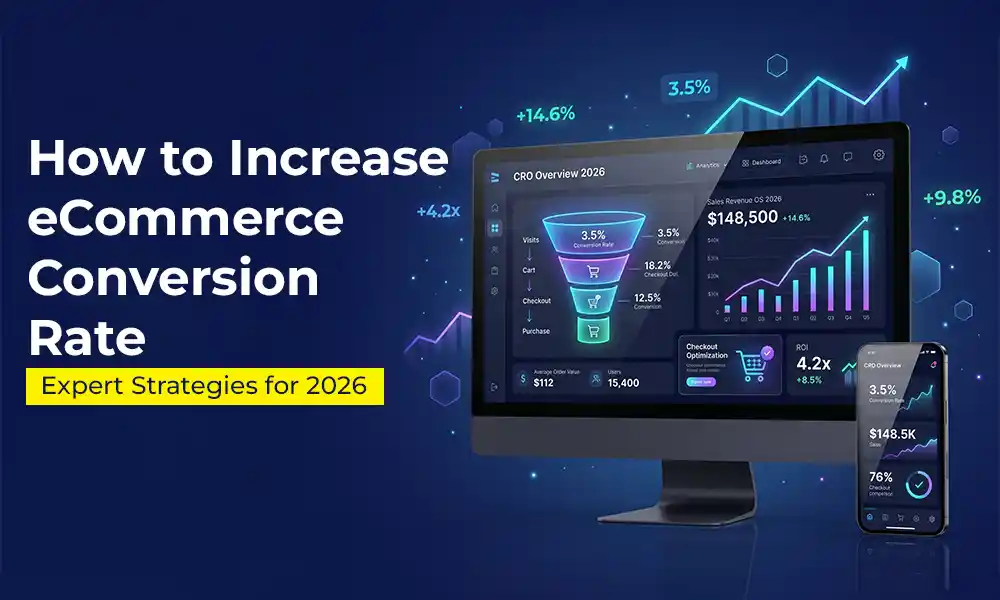
Conversion rate is the percentage of visitors on your website who complete a desired action, like making a purchase, filling a form, or making a call. In the UK, the typical conversion rate for a business doing well is between 2.5% to 3.5%. Even a small change in your processes can bring significant improvement and impact on your revenue.
Conversion, otherwise known as CRO, is not only about boosting sales; it affects your organic and paid traffic. Whether your website gets traffic from Google search or a PPC ad, it is very important that you optimise the path from the visit until the purchase to maximise the return on investment (ROI).
In this blog, we will go through the following:
- Conversion Fundamentals
- Optimising User Experience for Conversions
- Persuasive Design & Psychological Tactics
- Audience Targeting & Segmentation
- Paid and Organic Traffic Optimisation
- Post-Purchase Optimisation
- Leveraging AI & Advanced Personalisation
- Testing & Continuous Improvement
Understanding Conversion Rate and Its Metrics
There are some basics you need to understand before taking a deep dive into conversion rate details.
Conversion vs Conversion Value
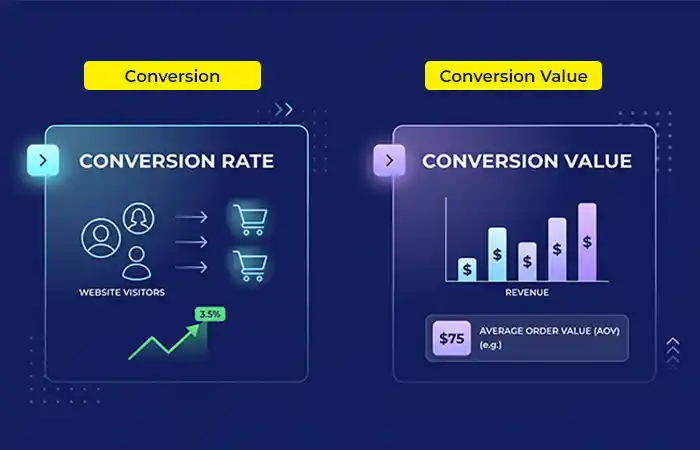
Conversion is exactly how many visitors convert. The value of those conversions is not specified, which can create roadblocks, and you may even incur more loss than return if you do not have a clear number in hand.
That is why Average Order Value and Revenue per Visitor come in.
Average Order Value: It tells the average amount of money a customer brings in per transaction on the website. It is calculated by dividing total revenue by the number of orders (Total Revenue ÷ Number of Orders).
Revenue per Visitor: It measures the average revenue generated from each site visitor. It is calculated by dividing the total revenue by the total visitors.
Based on these two metrics, we can conclude that conversion rate is the percentage of visitors who are buying from your website, while conversion value is the monetary return you get per visitor or per transaction.
Disclaimer! Do not solely focus on the percentages. Increasing conversion from 2 to 3% is great, but if those sales are of low margins, the revenue impact might still be limited. When you combine your conversion rates with AOV, you ensure your profits are optimised, not just the volume.
Additional Key Performance Indicators (KPIs) to Track
If you want to truly improve conversions, track the supplementary KPIs like:
- Bounce Rate: High bounce rates mean you have poor landing pages.
- Cart Abandonment & Checkout Drop-offs: Too many hurdles during checkout, or a lot of friction points.
- Time on Page & Scroll Depth: Measure the engagement with the content available on the website.
- Post-purchase Metrics: Measure the repeat purchases, customer lifetime value (CLV), and loyalty programme uptakes.
These metrics provide a clear context of where the CRO efforts have the greatest impact.
Optimising User Experience for Conversion
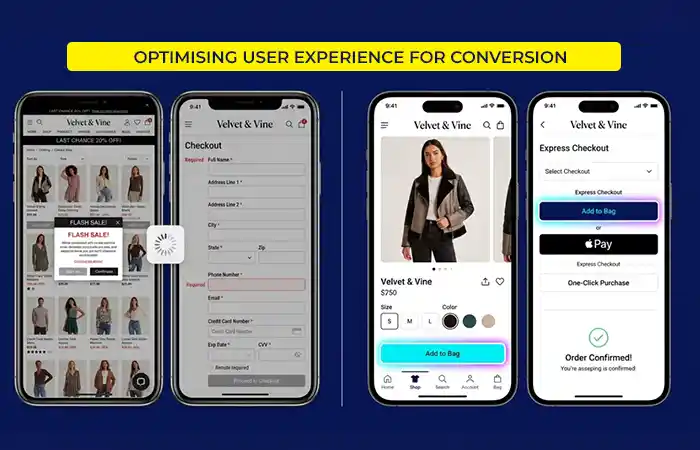
Mobile optimisation and technical SEO have a crucial impact on user experience and resultantly on conversion.
Mobile-First Optimisation
Global statistics show that in 2025, the revenue from mobile ecommerce reached $2.5 trillion dollars, doubling over the subsequent four years globally. For the UK only, nearly 80% of e-commerce traffic comes from mobile (Statista, 2025). Thus, mobile optimisation is non-negotiable.
Key Strategies
Here are some of the most effective strategies you can apply to make your e-commerce store almost fully optimised for mobiles:
- Responsive Designs: Your website design should be responsive for all devices, i.e., mobile, tablet, iPad, laptop, and desktop.
- Fast Loading Times: A 1-second delay in loading time reduces conversions by 7%.
- Mobile Payment Options: The payment should be one click or touch away; Apple Pay, Google Pay, PayPal.
- Simplified Checkouts: Reduce the steps towards checkout, allow autofill forms, and enable guest checkouts.
Big eCommerce platforms like Shopify and VWO emphasise that mobile-first conversion rate optimisation is a critical factor in boosting conversions.
Technical SEO’s Impact on Conversion
Technical SEO has a long term positive impact on search visibility, user experience and e-commerce conversion rates.
- Site Speed: If your site is slow, you automatically see 20-30% lower conversion rates.
- Structured Data: It improves your product’s visibility in search results.
- HTTPS, Canonical URLs, and Error Pages: secure pages and fewer error pages maintain trust and reduce friction in converting.
- Internal Linking & Product Discoverability: They help users find, understand and adopt a product page, relevant categories, or its features easily.
If your website is technically sound and straightforward, it ranks better and pushes the user towards purchase swiftly.
Persuasive Design & Psychological Tactics
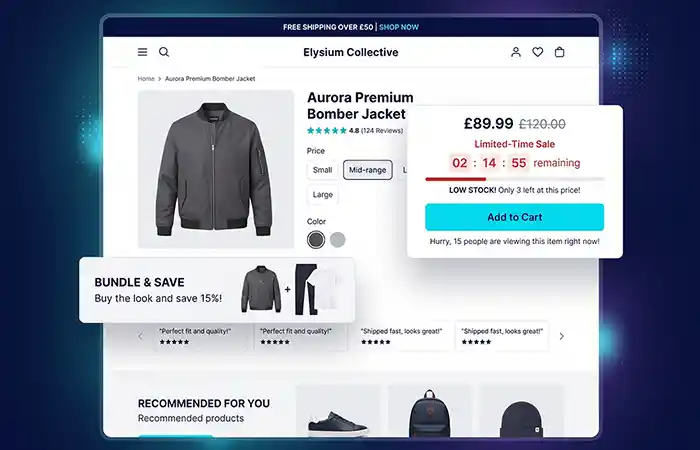
Web design and promotions play a more critical role than you can imagine.
Pricing & Promotional Psychology
When you understand human psychology, you convert more leads. Most successful businesses increase their conversions by:
- Anchoring and Decoy Pricing: They add high-priced products in their ranges to make mid-range products more appealing.
- Limited-time Offers: They create urgency to buy from your e-commerce business.
- Highlight Discounts & Free Shipping Thresholds: When you give clean and clear incentives, you increase the likelihood of purchase.
One UK fashion retailer shared with us that they increased their conversion by 18% after they added a “Free Shipping over £50” giving a prominent message on the product pages.
Social Proof & Urgency
Your target market’s trust is directly proportional to higher conversion rates. Drive actions through:
- Reviews and Ratings: Statistics show that businesses see a 15-20% increase in conversions when positive reviews are displayed on their websites, social platforms and GBP profiles.
- Scarcity and Countdown Timers: Encourage faster decision-making and conversions.
- User-generated Content and Influencer Endorsements: Real people and recommendations boost credibility and engagement.
Upsell & Cross-Sell Strategies
You can smartly maximise your revenue per visitor through recommendations. Here is how you do it:
- Bundle Purchase and Post-Add-to-cart Suggestions: It increases Average Order Value (AOV)
- Lifecycle-based Recommendations: Offering different offers for new vs repeated customers.
- AI-powered Personalisation: Recent case studies show that the conversion rates increase 10-25% by using predictive product recommendations.
Audience Targeting & Segmentation
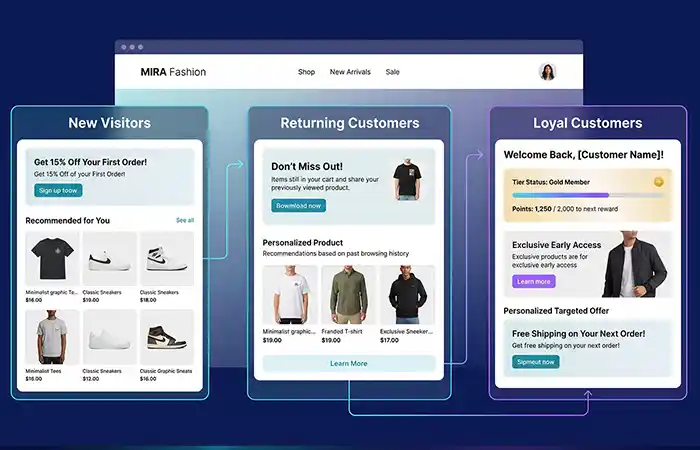
Customer segmentation and targeting help in increasing your online retail potential.
Customer Segmentation
Not all of the visitors behave the same way. New visitors may respond better to introductory offers, while returning customers may respond better to loyalty incentives or tailored product suggestions.
That is why treating them the same way will limit the conversion potential of your business. Segment your customers by their:
- Behavior
- Purchase History
- Demographic Data
It allows you to convey more relevant messaging. Behavioural segmentations will enable the dynamic content to adapt to user intent in real time.
Lifecycle-based Strategies
Do you think conversion ends when customers check out? Yes, if you are not planning to remain in business for the long run. Business owners who want to build a legacy with their businesses focus on lifecycle marketing. It ensures that the customers continue to engage with your business.
Use:
- Abandoned cart emails to recover lost revenue
- Reengagement campaigns to bring dormant customers back to the fold
- Subscription models and loyalty programmes to provide predictable recurring revenue and increased lifetime value.
Brands that prioritise retention typically outperform those that focus solely on acquisitions.
Paid and Organic Traffic Optimisation
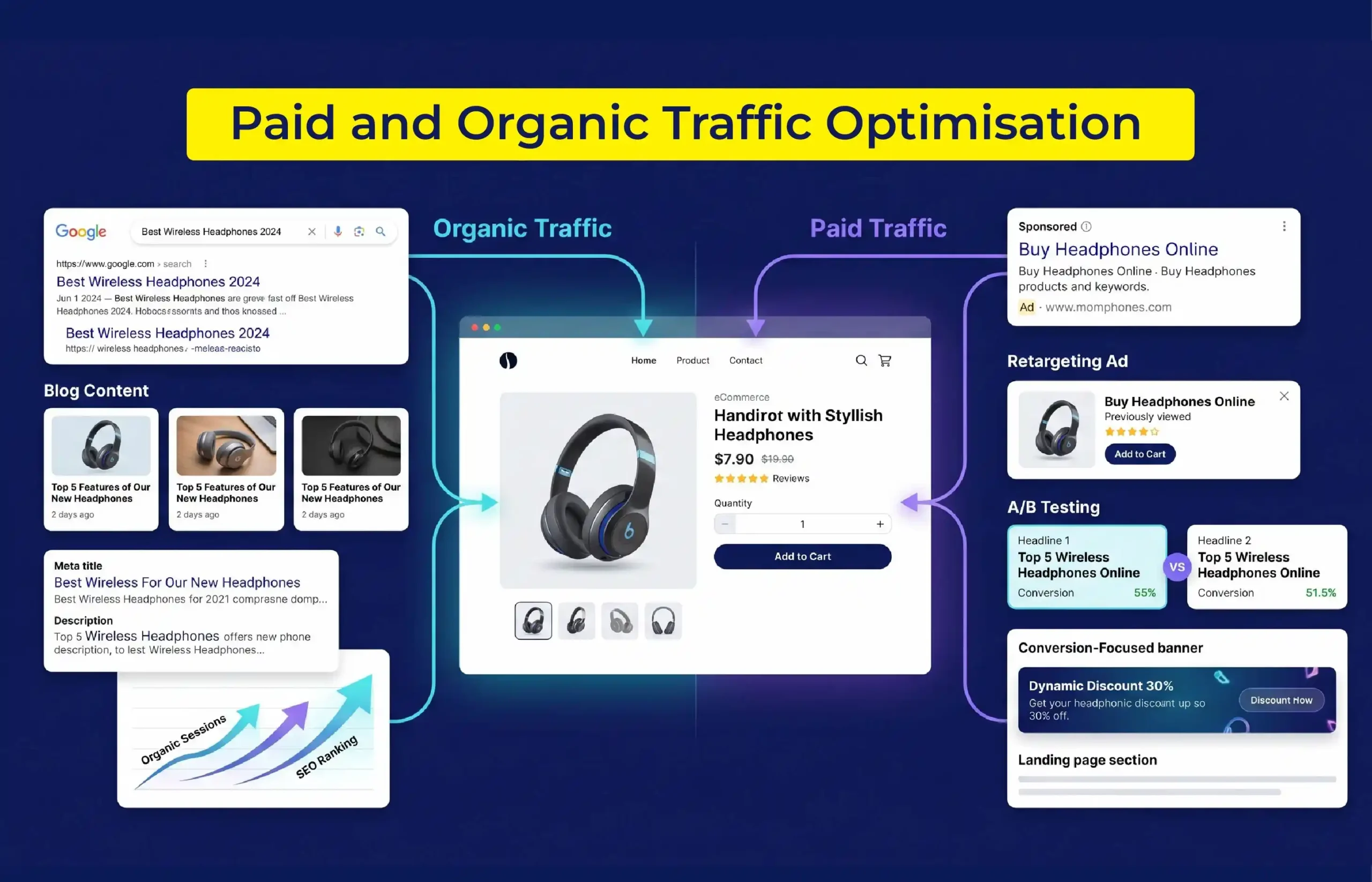
Paid and organic traffic move together to boost conversion and make your online brand name.
Organic Conversion Tactics
Organic traffic is valuable because it reflects the active search intent, which you can track with tools like GSC and GA4. However, when you rank well, you have conquered half the battle. To outperform, you need to make sure that:
- The landing pages are closely aligned with user expectations
- The product benefits are clearly stated
- You have a persuasive call to action
It is also necessary to have well-crafted meta titles and meta descriptions to improve CTR (Click-through rates) from the search results, with supporting blog content and buying guides that build authority and trust. Content marketing addresses real customer questions and, very naturally, navigates the users towards product pages.
Paid Conversion Tactics
Alignment is critical for paid campaigns. If the PPC advert promises a discount or a specific benefit, the landing page must immediately reflect that promise. If you have an inconsistency in your brand, there is a high chance that the bounce rate will accelerate, wasting your budget.
Retargeting your ads helps visitors who did not convert on their first visit. Continue A/B testing of the ad copy, headlines and offer placement to ensure that the campaign evolves based on the real data rather than mere assumptions.
Post-Purchase Optimisation
The Thank You page is often overlooked after checkout, yet it presents another opportunity to drive further revenue. Recommending other complementary products and offering limited-time discounts on future purchases can encourage immediate repeat sales.
- Collect reviews shortly after the purchase to strengthen your social proof.
- Refer programmes to incentivise the customers to promote your brand.
- Send follow-up emails with useful content, product care advice, or personalised recommendations.
These will not only maintain engagement and your brand’s memory in your customers’ minds, but also increase the chances of repeat purchase rates.
Leveraging AI & Advanced Personalisation
Artificial intelligence is a big part of the e-commerce industry and the conversion strategies.
- AI-powered recommendation engines analyse behavioural data and use that to predict which product will have more visitors and conversions.
- Dynamic pricing tools are able to adjust promotions based on demand and on customer profiles.
- Chatbots and real-time support tools effortlessly reduce friction by answering customer questions instantly, especially during checkouts.
InfoTech Business Solutions suggests that if you are a retailer, AI personalisation can bridge the gap between browsing and buying by delivering a highly relevant experience to customers at scale.
Testing & Continuous Improvement
Conversion tools work their best when constantly tested and improved. Testing tools like A/B testing and Google Analytics help you produce meaningful gains and reveal how your visitors react while interacting with your website.
A/B and Multivariate Testing
You can say you have an effective CRO when it relies on continuous experimentation to maximise ROI. Testing the following can reveal unexpected factors and insights:
- Variations of headlines
- Imagery
- CTA buttons
- Page layouts
Some of the most popular testing tools are VWO, AB Tasty, Optimizely and Dynamic Yield.
Conversion funnel testing is particularly valuable. It allows you to streamline checkout forms, reduce unnecessary fields and rearrange payment options to reduce drop-offs.
Analytics & Reporting
The data provided should guide every decision related to optimisation. The following tools make your analytical and reporting journey way easier:
- Google Analytics: Provide visibility of the user journey
- Hotjar and Crazy Egg: These heatmapping platforms reveal how visitors interact with your website’s individual pages
- Tracking Incremental Improvements: Ensure the changes deliver measurable revenue impact
- Attribution Modelling: Clarifies which channel contributes the most to conversions.
All of these tools provide you with assistance in increasing CRO and smart allocation of your marketing budgets.
Summary
Awareness of how to increase eCommerce conversion rates means you have a balanced strategy of combining technical performance, persuasive psychology and intelligent personalisation. Build your unshakable foundation on mobile-first UX, fast loading speeds, and seamless checkout flows.
Enhance persuasion through your effective pricing strategies, social proof and urgency. Strengthen your long-term value with segmentation and lifecycle marketing and drive incremental gains through AI-powered recommendations and ongoing testing.
As a business owner or CRO optimiser, your priority should be building a technically sound and customer-centric website and then refining it continuously through data-led experimentation. Combining all the strategies of SEO, paid traffic, and CRO, you ensure that your conversion growth is predictable, rather than accidental.
FAQs About Conversion Rates
What’s a good eCommerce conversion rate?
2.5-3% is considered an average conversion rate in the UK. High-performing stores often achieve 5% or more, depending on the sector they are in and the traffic quality they receive.
What is the conversion rate of eCommerce?
Conversion rate is the percentage of website visitors who complete the desired action of making a purchase, filling a form, or making a call to order.
How do you calculate conversion rate for eCommerce?
The number of Conversion rate divided by the total number of visitors multiplied by 100.
Is a 50% conversion rate good?
%0% conversion rate is excellent but very rare in eCommerce businesses. They are typically seen only in highly targeted campaigns or niches in a B2B environment.
What is the average conversion rate for eCommerce in the UK?
Most eCommerce retailers in the UK operate between 2.5% and 3%. However, the performance of the business depends on the industry, pricing, and traffic sources.