Most small businesses do one of two things with SEO: ignore it entirely, or hand money to an agency and hope for the best. Neither works. The first leaves you invisible. The second, without understanding what you’re paying for, leaves you vulnerable to being charged for very little.
This guide is for business owners who want to actually understand their effective SEO strategy for small business, not just outsource the confusion. We’ll cover what matters, in the order you should tackle it, through the lens of a real-world scenario: a small British skincare brand called SERENE.
| Meet Serene SERENE is a small beauty brand based in Bristol, founded by Priya and her business partner Meg. They sell a curated range of skincare products, cleansers, serums, tinted moisturisers, formulated with minimal, traceable ingredients. They have a Shopify store, an Instagram following of around 4,200, and a modest budget. Priya describes her relationship with Google as ‘complicated.’ When we met them, SERENE had been trading for fourteen months. Their site gets around 320 visitors per month, almost all of it from Instagram. They have no idea what their organic search traffic looks like because they’ve never set up Google Search Console. |
- Why SEO Matters for Small Businesses in 2026
- Before You Touch SEO: The Non-Negotiable Foundations
- What to Look For in an SEO Agency (and what to walk away from)
- What a Credible Agency Should Offer
- The Most Common SEO Mistakes Small Businesses Make
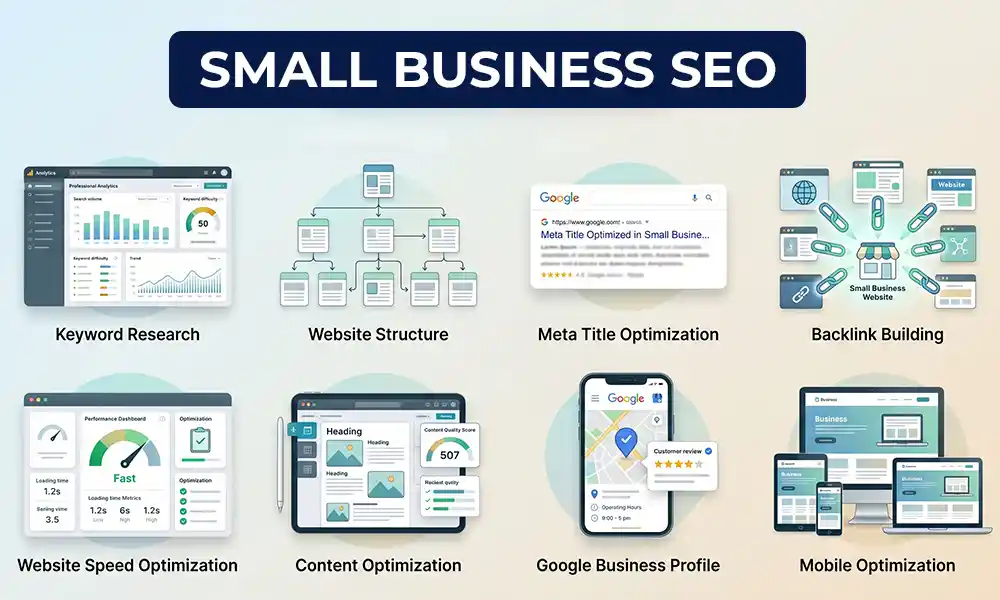
- The Results-driven SEO Strategy: Step by Step
- Step 1: Research and Analysis
- Step 2: On-page SEO
- Step 3: Technical SEO
- Step 4: Off-page SEO and Link Building
- Step 5: Local SEO
- Step 6: Tracking, Iteration, and The Long Game
- The Takeaway
Sound familiar? Good. Let’s start where most guides don’t: why this matters before the how.
Why SEO Matters for Small Businesses in 2026
The Honest Comparison: Traditional Marketing, PPC, and Organic Search
Print, leaflets, and word-of-mouth are not dead, but they are expensive relative to what they can measure. A leaflet drop across Bristol might cost £600 and convert at rates you’ll never accurately track. That’s not a reason to abandon them entirely, but it is a reason to think carefully about where compounding returns actually live.
Pay-per-click (PPC) advertising, Google Ads, gives you immediate visibility. The trade-off is brutal: the moment your budget stops, so does your presence. In competitive UK niches like skincare, cost-per-click can sit anywhere between £1.50 and £4.50, sometimes higher. A modest monthly ad spend of £500 can feel like it’s barely moving the needle.
Organic search is slower to build. Meaningful traction typically takes three to six months minimum, and that’s with consistent effort. But what you build through SEO doesn’t stop working the moment you close your laptop. A well-optimised product page and a handful of quality backlinks built this year can drive traffic for three years.
PPC is renting visibility. SEO is buying it.
One ends when the money stops; the other compounds.
What a Realistic Budget Looks Like
For a small business in the UK, rough market rates currently sit around:
- Freelance SEO Consultant: £400–£900/month for part-time support
- Small SEO Agency Retainer: £800–£2,500/month depending on scope
- One-off Technical Audit: £300–£800
- DIY (Your time + Tools): £0–£150/month in software costs
The honest frame is cost per lead over 12–24 months. SEO leads, people who found you because they were already searching for what you offer, convert at a meaningfully higher rate than cold paid traffic. That calculus shifts significantly in SEO’s favour the longer the time horizon.
| Serene’s Situation Priya gets a cold email from an SEO agency offering ‘page one rankings in 60 days’ for £350/month. The proposal includes no audit, no keyword research, and a guarantee. She almost signed up. She doesn’t but only because a friend flags it. We’ll come back to what made it a red flag. |
Before You Touch SEO: The Non-Negotiable Foundations
Most SEO strategies for small businesses guide miss or ignore this completely, but it is very crucial to know. Don’t start an SEO strategy without these in place; they’re not optional.
- A Properly Built, Indexable Website: Not just any website. One that loads quickly, works on mobile, and isn’t accidentally blocking Google from crawling it.
- Google Business Profile (GBP): Claimed, verified, and fully completed. Not just created and forgotten.
- Google Search Console: The single most useful free tool in SEO. If you don’t have it set up, you are flying blind.
- Google Analytics 4: So you can see what happens after people land on your site.
- Consistent NAP: Your Name, Address, and Phone number must be identical across every directory, social profile, and listing. Inconsistencies genuinely hurt local rankings.
Serene’s Situation
| Check | Status | Note |
| Google Search Console | Not set up | Critical — fix first |
| Google Business Profile | Created, incomplete | Missing hours, photos |
| Analytics 4 | Not connected | No conversion data |
| NAP consistency | Inconsistent | Wrong postcode on Yell |
| HTTPS / SSL | Active | Handled by Shopify |
| Mobile performance | Slow | Images uncompressed |
Priya sets up a Search Console in the afternoon. Within 48 hours, she can see that SERENE’s site is getting impressions for searches she had no idea about, including ‘gentle cleanser for sensitive skin UK’ but the click-through rate is low because the page titles are weak and generic.
What to Look For in an SEO Agency (and what to walk away from)
Before we get into strategy, let’s address the agency question directly, because many readers are evaluating whether to do this themselves or hire someone. The answer is usually both; understand it yourself, then hire selectively.
What a Credible Agency Should Offer
- A site audit before proposing anything; no audit means no diagnosis
- Transparent monthly reporting via Search Console, GA4, and rank tracking
- Clear deliverables: specific pages, keywords, and content per month; not ‘ongoing optimisation’
- Real UK SME case studies with results they can point to
- Honest timelines; anyone promising page one in 30 days is either lying or targeting keywords nobody searches
Red Flags to Walk Away From
|
The Most Common SEO Mistakes Small Businesses Make
- Targeting Keywords That Are Too Broad: “Skincare” has an enormous search volume and is dominated by Boots, LOOKFANTASTIC, and Cult Beauty. A small brand has no business competing there at the start.
- Ignoring Local SEO: If most of your customers are within 20 miles of you, local SEO is your highest-leverage channel. Many SMEs skip it entirely.
- Treating SEO as a One-off Project: Publishing ten blog posts and then stopping is not a strategy. It’s a sprint with no finish line.
- Building Low-quality Backlinks: A hundred links from irrelevant directories are worth less than one mention in The Grocer or a niche beauty trade publication.
- Neglecting Google Business Profile After Setup: Creating it and leaving it dormant is almost as bad as not having it.
| Serene’s Mistake In their first six months, SERENE’s website had a blog section with three posts, all titled things like ‘Our Story’ and ‘Why Clean Beauty?’ Neither was targeting a keyword anybody searched. Neither had internal links. Both were written the way you’d write an Instagram caption. Good content for social. Invisible to Google. |
The Advanced SEO strategy: Step by Step
Here is the sequence that actually works. Not every business will start at the same point, but the order matters.
Step 1: Competitor Research
Before you create a single piece of content or change a single title tag, know who you’re competing with in search. Not just your commercial competitors, your search competitors, which can be different.
Identify three to five brands or sites ranking for your most important terms and look at what’s working for them. Free tools like Ubersuggest or the basic tier of Moz give you enough to start. Paid tools like Ahrefs or Semrush are genuinely worth the investment once you’re past the basics.
What you’re looking for: their top-performing pages, where their backlinks come from, and THE GAPS. What are people searching for that nobody is answering well?
| Serene’s Competitor Analysis Priya spends an afternoon with the free version of Ubersuggest. She identifies four competitors in her search space: two indie brands, one subscription box, and one larger retailer with a clean beauty section. She finds that none of them have answered the question ‘is niacinamide safe for rosacea-prone skin’ in any useful depth. That’s a real search. That’s a real opportunity. She marks it down. |
Keyword Research: Intent Over Volume
The most important shift in how to think about keywords: stop optimising for volume, start optimising for intent. A keyword with 200 monthly searches and clear commercial intent is worth more than a keyword with 5,000 searches from people who will never buy from you.
For small businesses, long-tail keywords are the realistic ranking opportunity. They have lower competition, more specific intent, and higher conversion rates.
Keyword | Intent | Priority |
| gentle cleanser for sensitive skin UK | Commercial | High |
| niacinamide for rosacea skin | Informational | High |
| clean skincare brands UK | Commercial | Medium |
| minimalist skincare routine dry skin | Informational | Medium |
| best serum for hyperpigmentation | Commercial | Medium |
| skincare Bristol | Local | High |
Website Audit: What You Can’t Fix If You Don’t Know It’s Broken
Run a crawl of your site using Screaming Frog (free up to 500 URLs). What you’re looking for: broken links, pages with missing title tags, duplicate content across similar product pages, and pages that are accidentally set to ‘noindex.’
SERENE’s audit surfaces four product pages with identical meta descriptions, two 404 errors from old Instagram links, and a homepage that loads in 6.2 seconds on mobile. All fixable. None of them are obvious without looking.
Step 2: On-page SEO
On-page SEO can be divided into content, HTML elements, and internal linking architecture. We’ll look at each individually. The content on your website should match the user intent and able to answer the queries of your customers/clients in a proper manner. Having said that Google always prefers content that is E.E.A.T focused or in short “helpful content” that address or satify the users search intent.
Title Tags and Meta Descriptions
Your title tag is the single most direct on-page signal to Google about what a page is about. Put your primary keyword near the front, keep it under 60 characters, and make it readable by a human, not a keyword list.
Meta descriptions don’t directly affect rankings, but they directly affect whether someone clicks. Treat them like ad copy: what problem does this page solve, and why should someone click yours over the others?
| Before optimisation serene-beauty.co.uk › products › cleanser Cleanser – Serene Beauty Our bestselling cleanser. Shop now. |
| After optimisation serene-beauty.co.uk › products › gentle-cleanser-sensitive-skin Gentle Cleanser for Sensitive Skin | Serene Beauty A fragrance-free, soap-free cleanser formulated for reactive and rosacea-prone skin. No harsh sulphates. Free UK delivery over £30. |
Heading Structure and Content
One H1 per page, matching what the user searched. H2s as the navigational skeleton of the page. H3s for supporting detail. The reason this matters for modern SEO goes beyond rankings: Google’s AI Overviews and featured snippets pull directly from well-structured headings and the paragraphs beneath them. If you want to appear in those placements, answer the question clearly and immediately under the relevant heading.
Internal Linking
Every page on your site should link to at least one other relevant page. This distributes what SEOs call link equity, the authority signals that flow through your site, and helps Google understand which pages are most important. Use descriptive anchor text. ‘Click here’ tells Google nothing. ‘Our guide to niacinamide for sensitive skin’ tells it quite a lot.
SERENE builds a simple pillar structure: a main ‘Skincare Ingredients’ hub page that links out to individual ingredient guides (niacinamide, hyaluronic acid, ceramides). Each guide links back to the relevant product pages. It takes two weeks to build and starts moving rankings within six weeks.
Step 3: Technical SEO
Page Speed and Core Web Vitals
Google’s Core Web Vitals measure real user experience; not just raw load time. The three signals that matter:
- LCP (Largest Contentful Paint): How quickly the main visible element loads. Aim for under 2.5 seconds.
- CLS (Cumulative Layout Shift): How much the page jumps around as it loads. Aim for under 0.1.
- INP (Interaction to Next Paint): How quickly the page responds to input. Aim for under 200ms.
For most small business sites, the biggest culprits are uncompressed images, render-blocking third-party scripts, and cheap shared hosting. Run your site through Google’s PageSpeed Insights. If your mobile score is below 50, that is costing you rankings.
LCP Before 6.2s Mobile homepage | LCP After 2.1s After image optimisation | CLS 0.04 Within target | PageSpeed Score 74 Mobile (was 31) |
Schema Markup
Schema is code you add to your pages that helps Google understand what they contain, and surface that information directly in search results as rich results. For a small business, the most important schemas are:
- LocalBusiness: Name, address, phone, opening hours, geo-coordinates
- Product: Price, availability, reviews
- FAQ: Feeds directly into featured snippets and AI Overviews
SERENE adds LocalBusiness schema to their Bristol-based contact page and Product schema to each product page. Within three months, their product listings start appearing with star ratings and price ranges directly in Google’s results without any paid placement.
Crawling, Indexing, and Sitemaps
Your robots.txt file tells Google what it can and cannot crawl. Most small business sites don’t need anything complex here, but it’s worth checking that you haven’t accidentally blocked important pages. Submit a clean XML sitemap, only indexable, canonical URLs, via Search Console, and update it whenever you publish new content.
Step 4: Off-page SEO and Link Building
Backlinks, other websites linking to yours, remain one of Google’s strongest ranking signals. But the quality of those links matters far more than the quantity. One link from a genuine UK beauty editor’s blog or a trade publication like Professional Beauty is worth more than fifty links from generic directories you’ve never heard of.
Guest Posting and Earned Coverage
Identify industry-adjacent publications: local Bristol lifestyle blogs, clean beauty trade sites, ingredient-focused wellness publications. When you pitch, lead with what you can offer their readers: a genuinely useful guide, a piece of research, a distinctive point of view, not a request for a link. The link should be the natural consequence of good content, not the opening task.
| Serene’s First Backlink Win Meg pitches a short piece to a Bristol-based sustainability newsletter on the environmental cost of fragrance in skincare. No link request in the pitch. The newsletter publishes it, links to SERENE’s fragrance-free cleanser, and sends 180 referral visitors in a week. That one link, from a site with genuine local authority, moves SERENE’s ranking for ‘fragrance-free cleanser UK’ from position 34 to position 18 within six weeks. |
Business Directories and Local Citations
Register your business on relevant UK directories; Yell, Thomson Local, and sector-specific platforms like Checkatrade if applicable. The SEO value here is citation consistency, not domain authority. Every listing should show your NAP exactly as it appears everywhere else. Don’t bulk-submit to 200 directories; focus on 10–15 relevant, authoritative ones.
| Avoid Backlink Schemes If someone is selling you 50 backlinks from ‘high DA sites’ for £200, those links will either do nothing or actively harm your site. Google’s spam policies are explicit. The risk isn’t worth the marginal gain even if they seem to work short-term. |
Step 5: Local SEO
If a meaningful proportion of your customers are in a specific geographic area (even if you also sell nationally) local SEO deserves dedicated attention. The local pack (the map results that appear above organic results for location-based searches) is prime real estate, and it’s genuinely achievable for small businesses who do the basics properly.
Google Business Profile: Treat it Like a Channel, Not a Form
Complete every section: primary and secondary categories, services, opening hours, a genuine description that uses your key terms naturally, and at least ten photos. Then post it weekly.
GBP posts are indexed. A weekly post about a new product, an ingredient spotlight, or a local event keeps your profile active and signals to Google that the business is current.
Reviews: The Most Underused Local Ranking Signal
Volume and recency of Google reviews both matter for local pack rankings. The strategy is simple: ask at the moment of satisfaction, when a customer messages to say their skin has improved, when someone picks up an order in person, when you’ve just had a positive exchange. Don’t offer incentives; it violates Google’s policies and the risk of a penalty far outweighs the short-term gain.
Respond to every review. Every single one, positive and negative. A considered, professional response to a critical review does more for trust than ten five-star ratings you ignore.
| Serene’s Review Moment A customer named Claire leaves a detailed five-star review about how SERENE’s niacinamide serum calmed her rosacea after a year of trying other products. Meg responds personally, thanks Claire by name, and mentions the ingredient rationale they went with. That exchange is now visible to everyone who looks at SERENE’s GBP listing. Three months later, SERENE appears in the local pack for ‘skincare Bristol.’ They have 73 reviews. Their nearest local competitor has 14. |
Location pages
If you serve multiple areas, create individual location pages for each but only if they’re genuinely unique. A copy-pasted page with the town name swapped is worse than nothing; Google treats it as thin content and it can trigger duplicate content issues. Each page needs local context, local references, and ideally, local social proof.
Step 6: Tracking, Iteration, and The Long Game
SEO without measurement is just publishing and hoping. Here’s what to track, and how often.
Weekly
- Keyword rankings for your ten to fifteen priority terms. Use Search Console’s Performance report or a tool like Accuranker
- Any manual actions or coverage issues flagged in Search Console
Monthly
- Organic traffic trend in GA4 (look at sessions and engagement rate, not just pageviews)
- Click-through rate on your top-impression pages. If you’re getting impressions but no clicks, your title tags need work
- Backlink growth and new referring domains
Quarterly
- Which content is performing and which isn’t; update underperformers before creating new content
- Whether your keyword targets still reflect your actual business priorities
- Budget and resource reallocation based on what’s moving
What SERENE’s First Year Looked Like
| Organic sessions/month 320 → 2,840 After 12 months | Keywords ranking 4 → 61 Top 20 positions | Google reviews 3 → 73 4.9 average | Local pack #2 “Skincare Bristol” |
| The Honest Caveat These numbers are realistic for a business that does the work consistently over twelve months. They are not guaranteed; SEO has too many variables for guarantees. Niche, competition, budget, and execution quality all affect the outcome. What’s consistent is the direction of travel when you do this properly. |
The Takeaway
Priya and Meg didn’t start SERENE as SEO experts. They started it as people who cared deeply about their products and their customers, and who gradually learned that visibility online follows the same principles as visibility everywhere else: be clear about who you are, be findable where your customers are looking, and be consistent over time.
The Strategic SEO approach for small business isn’t a shortcut. It isn’t something you set up once. It’s a channel: one that gets more valuable the longer you invest in it, and one that doesn’t stop working when your ad budget runs out.
The gap between a business that shows up on Google and one that doesn’t is rarely talent. It’s usually just this: someone did the work, in order, and kept going.
Not Sure Where to Start?Whether you’re evaluating an agency or building your own SEO foundation, a proper audit is always step one. Without one, you’re guessing. |