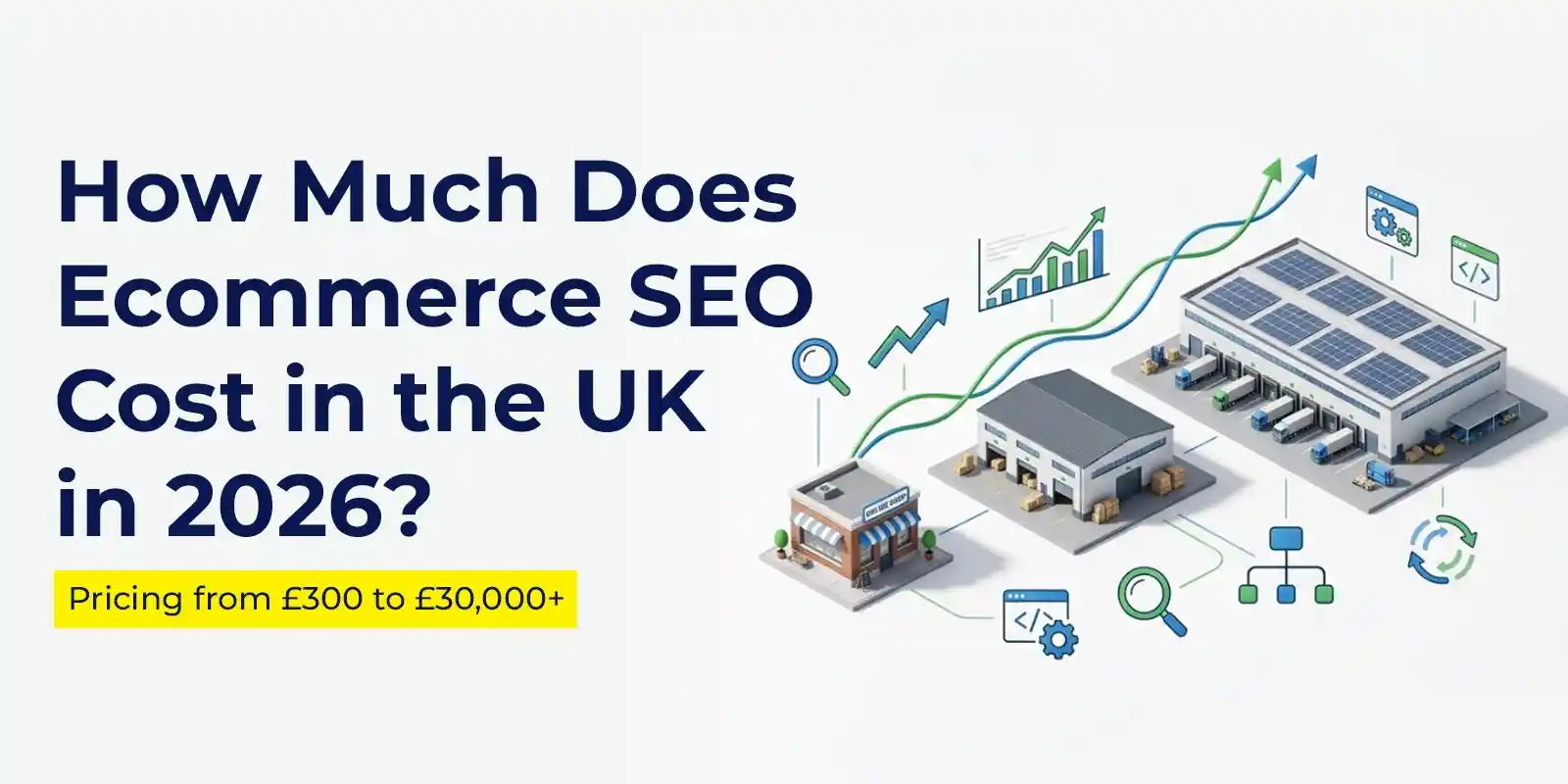
Most UK ecommerce brands pay £1,500–£6,000 a month for SEO. Sole traders and local
shops can get meaningful visibility for £300–£800. Enterprise catalogues with hundreds
of SKUs and multi-region targeting run £5,000–£30,000+. Freelancers typically charge
£40–£200+ per hour. The rest of this guide explains why businesses fall at different
points within that pricing range.
It Comes Down to Catalogue Size, Not Industry
| Business Type | Monthly SEO Cost | What You’re Actually Paying For |
|---|---|---|
| Sole Trader / Local | £300–£800 | Google Business Profile optimisation, citations, and a handful of local pages. |
| Small Business | £500–£2,000 | On-page fixes, technical clean-up, and regular content creation. |
| SME | £1,500–£5,000 | Complete SEO strategy including content, links, technical work, and reporting. |
| Enterprise | £5,000–£30,000+ | International SEO, AI search visibility, technical SEO, and a dedicated team. |
A 200-SKU Shopify store and a 20,000-SKU multi-warehouse Magento site are both ecommerce businesses,
but the larger site requires faceted navigation fixes, log-file analysis, and international hreflang
implementation. That additional technical complexity accounts for most of the price difference.
A sole trader selling handmade goods usually needs local visibility and a few well-optimised category
pages, which explains the £300–£800 range.
Small businesses with 50–300 products typically require ongoing on-page optimisation and content,
pushing costs into the £500–£2,000 bracket.
SMEs managing several hundred products in competitive markets generally need link building, reporting,
and long-term strategy, which places pricing around £1,500–£5,000 per month.
Enterprise retailers operate at a completely different scale, often with multiple regions, currencies,
and development teams, so pricing commonly starts at £5,000 per month and has no real
upper limit.
The Four Ways You’ll Actually Pay
Monthly Retainer
The most common pricing model. SEO compounds over time, making an ongoing retainer the best fit for
businesses looking for sustainable growth. Most SMEs spend between £1,500–£5,000 per month.
Hourly
Suitable for audits or one-off technical fixes, such as recovering from a Shopify migration.
Rates generally range from £40–£200+ per hour.
Project-Based
A fixed fee for clearly defined work, such as migrating thousands of URLs without losing rankings.
Performance-Based
You pay based on rankings or traffic improvements. While available, it’s relatively uncommon in the UK
and should be approached carefully because it often prioritises quick wins over long-term technical health.
Freelancer vs Agency vs In-house
Ecommerce SEO Freelancer
Freelancers are generally the most affordable option and can work well for smaller catalogues. However,
you’re relying on one person’s expertise across every aspect of SEO.
Ecommerce SEO Agency
Agencies provide specialists in technical SEO, content, digital PR, and reporting. While they cost more,
they usually deliver broader expertise for growing businesses.
In-house Ecommerce SEO
Hiring internally becomes financially sensible once SEO investment reaches approximately
£4,000–£5,000 per month. Below that level, agency retainers are often more cost-effective.
What Actually Moves the Price?
- Catalogue Size: More products require more optimisation and maintenance.
- Competition: Highly competitive keywords demand significantly more work.
- Technical Debt: Duplicate content, poor redirects, and migration issues increase costs.
- Content Volume: Building topical authority requires consistent publishing.
- AI Search Monitoring: Tracking visibility in AI search experiences has become an additional service.
Why Has SEO Become More Expensive Since 2024?
- AI Overviews: Content must now be structured to appear in AI-generated search results.
- Stronger E-E-A-T Requirements: Thin, low-quality content is increasingly penalised.
- Greater Technical Complexity: Modern ecommerce platforms require deeper technical expertise.
Can AI Tools Reduce SEO Costs?
Partially. AI helps with keyword clustering, technical audit summaries, and first-draft content.
Human expertise is still essential for strategy, link building, technical SEO, and editorial review.
What Should Be Included in an SEO Package?
- Technical SEO
- Keyword Research
- On-page Optimisation
- Link Building
- Content Creation
- Reporting & Ongoing Maintenance
Can You Do Ecommerce SEO Yourself in 2026?
Basic optimisation, product descriptions, and local SEO can often be handled in-house.
Large catalogues requiring technical SEO, structured data, and digital PR generally benefit
from professional support.
SEO vs PPC: A Fair Cost Comparison
Pay-Per-Click (PPC)
PPC delivers immediate traffic but stops generating visitors as soon as advertising spend ends.
Search Engine Optimisation (SEO)
SEO takes longer to deliver results but continues generating traffic without paying for every click,
making long-term acquisition costs significantly lower for established ecommerce businesses.
FAQs About Ecommerce SEO Cost
How long does SEO take until I see results?
Typically 6–12 months for competitive keywords.
Do costs differ by platform?
Yes. Magento and headless ecommerce sites generally require more developer involvement than Shopify or WooCommerce.
What’s the actual risk of cheap SEO?
Recovering from poor-quality SEO can cost between £5,000–£15,000 and may take
6–18 months.
Is SEO still worth it compared with PPC?
Yes. PPC delivers immediate traffic, while SEO builds long-term organic visibility. Most successful
ecommerce brands invest in both.
Is ecommerce SEO worth the investment in 2026?
For most established online stores, yes. Organic traffic typically delivers a lower cost per acquisition
once rankings are established.
What’s the difference between freelancer and agency pricing?
Freelancers usually suit smaller catalogues, while agencies provide specialist teams capable of managing
larger, more competitive ecommerce websites.
Not sure which pricing tier is right for your business? A professional SEO audit can
quickly determine whether your website needs a modest monthly investment or a large-scale enterprise strategy.